Resilience in rural communities is not optional — it’s essential.
In rural America, we carry unique pressures: economic uncertainty, workforce shortages, agricultural stress, leadership gaps, isolation, and the unspoken expectation that we should “just handle it.”
But handling it and being healthy are not the same thing.
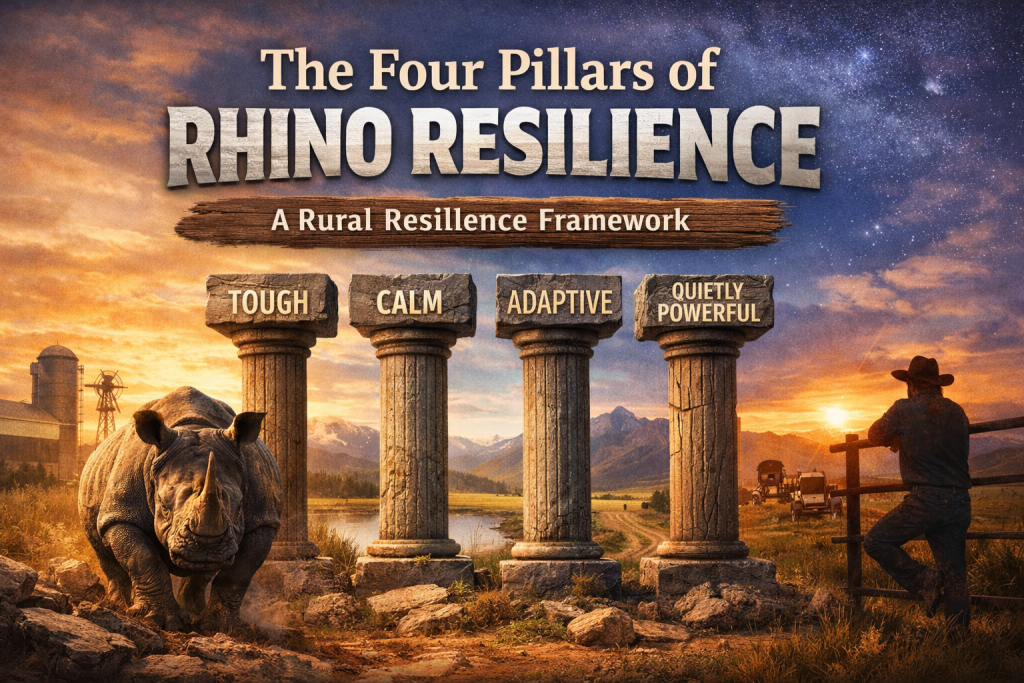
That’s why I developed the Four Pillars of Rhino Resilience — a practical rural resilience framework designed to strengthen mental health, leadership stability, and long-term capacity in rural communities.
This framework was built from over 20 years working in rural mental health and supporting educators, healthcare providers, coaches, farmers, ranchers, business owners, and community leaders.
But it is not just psychological.
It is symbolic.
The rhinoceros has long represented strength, grounding, and quiet power across ancient cultures. Rhino Resilience draws from that symbolism — not as decoration, but as identity.
Rhino Resilience is not about becoming harder.
It’s about becoming stronger and steadier at the same time.
Why Rural Communities Need a Resilience Framework
Motivation fades. Grit alone leads to burnout. Strength without structure collapses under chronic stress.
Rural mental health challenges are increasing across the country. Burnout in rural communities is not a personal weakness — it is often a predictable biological and systemic response to sustained pressure.
Resilience is not a personality trait. It is a structure.
The rhinoceros survives not because it is aggressive — but because it is built with structure: thick skin, grounded stance, powerful frame, and calm awareness.
Without structure, stress overwhelms us.
With structure, stress strengthens us.
The Four Pillars of Rhino Resilience provide that structure.
Pillar One: Tough with an Unbreakable Will
Rural life requires perseverance. Whether you are running a farm, leading a classroom, staffing a rural clinic, or building a small-town business, quitting when things get difficult is not an option.
But real resilience is not just about pushing through.
It is about protecting your purpose and passion — and giving yourself enough recovery to stay connected to it.
Because the first thing that begins to fade under pressure is not your strength… it is your “why.”
An unbreakable will means:
- Protecting your purpose and passion when the weight gets heavy
- Staying connected to your values even when motivation drops
- Recognizing when you need recovery before the wear turns into damage
- Continuing forward with intention — not exhaustion
The True Nature of the Rhino: Controlled Strength
The rhinoceros is not the fastest animal on the savanna. It is not the loudest. It is not the most dramatic.
But it does not move endlessly.
It rests. It conserves. It protects its energy.
And when it decides to move forward, very little can stop it.
Ancient symbolism often portrayed the rhino as a creature of singular focus and grounded power. It does not scatter. It does not second-guess.
This is not reckless aggression.
It is controlled force.
Tough with an Unbreakable Will reflects the rhino’s steady advance — not charging nonstop, but moving forward with strength, purpose, and recovery.
In rural resilience, this means we do not just endure.
We protect what gives us strength…
so we can keep going without losing ourselves.
Pillar Two: Calm and Steady
When stress hits, your body activates automatically — increased heart rate, shallow breathing, narrowed thinking. This is biology, not weakness.
Calm and Steady means:
- Regulating before reacting
- Pausing before making decisions
- Protecting your mental capacity under pressure
The True Nature of the Rhino: Calm Power
Despite their size and strength, rhinos spend most of their time grazing quietly. They conserve energy. They move slowly and deliberately.
They are not constantly charging.
Ancient symbolism associated the rhino with grounded awareness — a creature that stands firm and does not startle easily.
Calm is not the absence of strength.
It is strength under control.
In rural leadership — whether in Colorado communities or across rural America — calm stability protects families, teams, and organizations from chaos.
Calm and Steady is the nervous system equivalent of the rhino’s grounded stance.
Pillar Three: Adaptive and Wise
Clear thinking. Flexible action. Grounded decisions under pressure.
Life doesn’t go according to plan—especially in rural communities. Weather shifts, people change, and challenges show up without warning.
Adaptive and Wise means:
- Seeing situations clearly
- Adjusting when things change
- Making thoughtful decisions under pressure
- Learning from experience
At the core of this pillar is a simple process:
Observe → Orient → Decide → Act
You don’t need perfect answers.
You need the ability to see clearly, choose wisely, and keep moving.
Because resilience isn’t just about holding on—
it’s about knowing when and how to adjust.
The True Nature of the Rhino: Ancient Survivor
Rhinos are among the oldest large mammals still walking the earth. They have survived dramatic environmental shifts across centuries.
They are not delicate creatures.
They are adaptable survivors.
Ancient cultures saw the rhino as a symbol of endurance through changing landscapes. Survival was not about speed — it was about strength combined with adaptation.
In rural communities today, resilience requires honoring tradition while adjusting to modern realities.
Wisdom allows us to pivot without fracturing.
Adaptive and Wise reflects the rhino’s ability to endure across generations.
Pillar Four: Quietly Powerful
Quiet power is the ability to lead yourself and influence others through grounded presence—not force.
In small communities, reputation matters. Pressure is visible. Leadership is relational.
Quietly Powerful means:
- Confidence without arrogance
- Strength without intimidation
- Presence without noise
It’s how you carry yourself in the world—
in conversations, in conflict, and in moments when others are watching.
It’s about being someone others can rely on.
The True Nature of the Rhino: Sacred Presence
In ancient symbolism, the rhino was often seen as a creature of solitary strength. It does not travel in loud dominance. It does not perform for attention.
It simply exists in undeniable presence.
Its power is not loud — it is obvious.
Quietly Powerful is the integration of the other three pillars. It is strength that does not need applause.
In rural mental health and leadership, this is critical.
True resilience is not dramatic.
It is consistent.
It is reliable.
It is steady enough that others feel safer simply because you are there.
How the Four Pillars Strengthen Rural Mental Health
Each pillar reinforces the others:
- Toughness without calm becomes burnout.
- Calm without toughness becomes passivity.
- Adaptability without strength becomes instability.
- Power without humility becomes division.
Together, the Four Pillars create a complete rural resilience framework — strengthening individuals, families, schools, workplaces, and entire communities.
The rhino does not survive because of one trait.
It survives because of integrated strength.
That is Rhino Resilience.
Who the Rhino Resilience Framework Is For
This rural resilience model is designed for:
- Rural educators and school staff
- Healthcare providers and mental health professionals
- Coaches and youth mentors
- Farmers and ranchers
- Small-town business owners
- Parents raising resilient children
- Community leaders across rural America
If you live or lead in a rural community, this framework was built with you in mind.
The Future of Rhino Resilience
The Four Pillars are the foundation of a broader mission — strengthening rural mental health, leadership capacity, and long-term community resilience.
Through the Rhino Resilience podcast, speaking engagements, and future training initiatives, this framework will continue expanding to support rural communities across Colorado and throughout rural America.
Rural strength means standing strong!
But it also means never standing alone!
Welcome to Rhino Resilience!
— Chris “Rhino” Swenson
