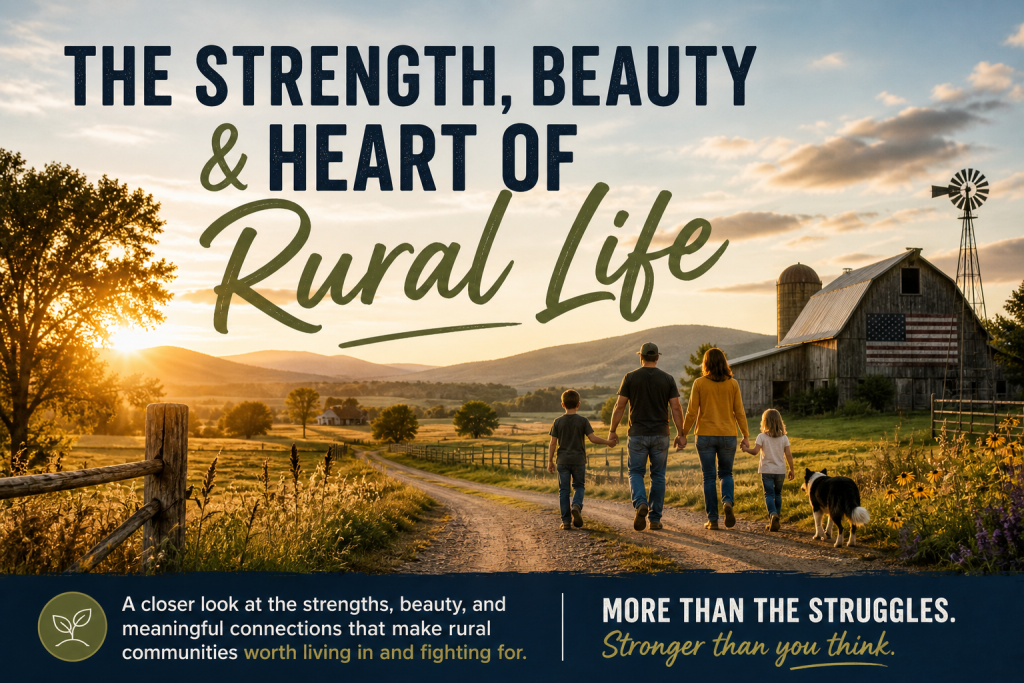
Why rural communities are more than their struggles—and why so many people choose to live here
We’ve Talked a Lot About the Problems…
Over the past several years, there has been a growing and important conversation around mental health in rural communities.
We’ve talked about:
- Higher suicide rates
- Limited access to care
- Isolation and distance
- Stigma around asking for help
And those conversations matter.
They’ve helped bring awareness to issues that were once ignored or pushed aside.
But somewhere along the way… something else has happened.
We’ve gotten so focused on what’s wrong… that we’ve stopped talking about what’s strong—and what’s good.
Rural Life Is Not the Problem
If we’re not careful, the message starts to sound like this:
“Rural communities are struggling… broken… behind…”
And that’s not the full story.
Because the truth is:
Rural communities are built on strengths—and a way of life—that many people have lost.
And those strengths aren’t just “nice qualities”…
They are protective factors for mental health.
The Beauty of Rural Life: Why People Choose to Stay
There’s a question people from outside rural communities ask all the time:
“Why would you want to live way out there?”
And if all they’ve heard is the negative…
It’s a fair question.
But those who live it know something different.
1. Space to Breathe
Out here, life isn’t stacked on top of itself.
There’s room:
- Room to think
- Room to move
- Room to live without constant noise
You can step outside and actually hear… quiet.
And in a world that never stops—
That kind of space is rare.
2. A Slower, More Grounded Pace
Not everything is rushed.
Not everything is urgent.
There’s a rhythm to rural life that’s tied more to:
- seasons
- weather
- real work
Instead of constant notifications and pressure.
And that pace…
gives people a chance to actually be present.
3. Real Connection
In rural communities, people know each other.
Not just names—but stories.
There’s a different kind of connection:
- deeper
- more personal
- more real
It’s not perfect.
But when it matters—
people show up.
4. Raising Families with Freedom
Kids grow up differently.
They have:
- space to explore
- room to fail and figure things out
- less pressure to constantly perform
They learn responsibility, work ethic, and independence early.
And many families choose rural life because of that.
5. A Sense of Meaning You Can Feel
There’s something about rural life that’s hard to explain unless you’ve lived it.
It’s in:
- the land
- the work
- the people
It’s a quiet sense of:
“This life means something.”
The Strengths That Still Exist in Rural Communities
1. Strong Sense of Community
In rural areas, people still show up.
When something goes wrong—you don’t just get a message…
You get people at your door.
Meals. Help. Equipment. Time.
That kind of connection is powerful.
2. Purpose-Driven Work
Whether it’s farming, ranching, teaching, or running a small business—
Rural work is often tied to something deeper:
- Family legacy
- Land stewardship
- Community contribution
That creates a strong sense of purpose, which is one of the most important anchors for mental health.
3. Resilience Built Over Generations
Rural life has never been easy.
Weather, markets, long hours, uncertainty—
People learn early how to:
- Adapt
- Endure
- Keep going when things get hard
That’s not weakness.
That’s trained resilience.
4. Independence and Capability
Rural individuals often know how to:
- Fix things
- Figure things out
- Handle pressure
There’s a quiet confidence that comes from knowing:
“If something goes wrong… I’ll find a way.”
5. Deep Roots and Identity
In many rural communities, people aren’t just passing through.
They’re connected to:
- Generations before them
- Land that carries meaning
- A way of life that shapes identity
That kind of grounding provides stability in a fast-changing world.
And This Is What Often Gets Missed…
The very things that make rural life meaningful…
Are the same things that can make it heavy at times.
But Here’s the Tension…
The same strengths that support rural life…
Can also become challenges if left unbalanced.
- Independence can turn into isolation
- Resilience can turn into silent suffering
- Pride can make it harder to ask for help
And this is where the conversation needs to evolve.
It’s Not About Replacing the Conversation—It’s About Balancing It
We still need to talk about:
- Mental health struggles
- Access to care
- Suicide prevention
- Burnout and stress
But we also need to recognize this:
Rural communities already have part of the solution.
The goal isn’t to “fix” rural life.
The goal is to:
Build on the strengths that are already there.
How We Move Forward
1. Start Talking About Strength Again
Not just survival—but what’s working.
Highlight:
- Stories of people helping people
- Community wins
- Everyday resilience
2. Redefine Strength
Strength isn’t just:
- Pushing through
- Staying silent
Real strength is also:
- Knowing when to reach out
- Letting someone else step in
- Taking care of yourself so you can keep going
3. Use Community as a Tool
The same way rural communities rally during a crisis—
We can rally around mental health too.
Check on people. Show up. Stay connected.
4. Protect the Good While Addressing the Hard
We don’t need to choose between:
- Acknowledging struggle
and - Honoring strength
We need both.
Final Thought
If all we ever talk about is what’s wrong with rural life…
We shouldn’t be surprised when people stop seeing what’s right about it.
Rural life isn’t perfect.
It can be hard. Demanding. Heavy at times.
But it’s also:
- Beautiful
- Meaningful
- Connected
- Grounded
And for many people…
It’s exactly where they want to be.
