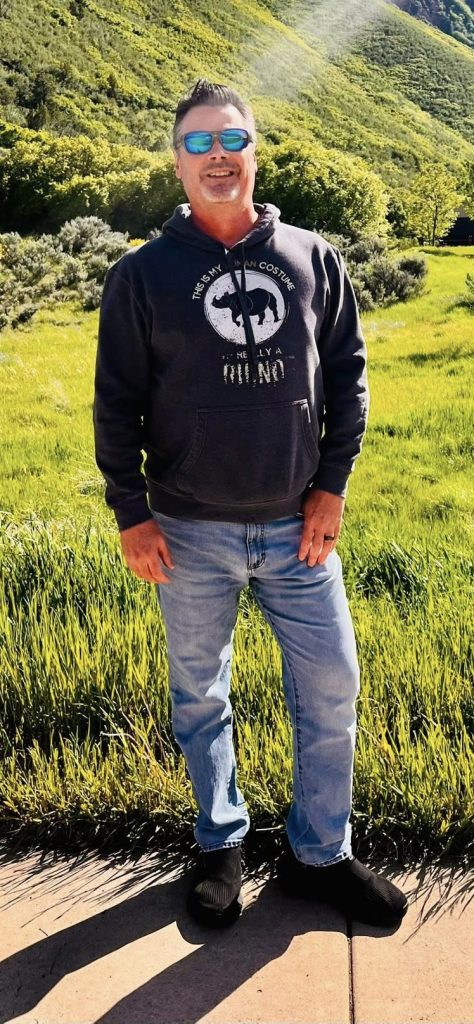
MY STORY
I Didn't Set Out to Build Rhino Resilience.
Rhino Resilience wasn’t born from a business plan. It grew slowly over decades—from my own journey and more than 20 years as a licensed therapist, sitting across from rural people in thousands of conversations as they tried to find their way through some of life’s hardest moments.
Along the way, I began to realize something. People didn’t need more complicated psychological language or another reminder that resilience matters. They needed practical ways to understand what they were carrying—and something useful they could actually do with that understanding.
Over time, the lessons I was learning about strength, struggle, recovery, purpose, connection, and what it really means to be resilient began coming together.
Eventually, those lessons became Rhino Resilience.
This is the story of how I became Rhino—and why I believe strengthening rural life starts with strengthening the people who call it home.
BECOMING RHINO
Sometimes a Symbol Finds You
Before 1999, if you had asked me what animal I connected with, I probably would have said an eagle. As a kid, all I wanted to do was fly airplanes. Eagles represented something I understood—the sky, freedom, and flight.
Then 1999 came, and I reached a point in my life where I needed to reconsider almost everything—what mattered to me, where I was going, and what direction I wanted my life to take.
And something strange started happening.
Rhinos seemed to be showing up everywhere.
I would notice a rhino in an image. I’d see one used in a business logo. Something would cross my path that had a rhino attached to it. These weren’t things I had been looking for, but for some reason I kept noticing them.
I didn’t understand why. I certainly wasn’t thinking about creating a brand or calling myself “Rhino.” There was just something about this animal that suddenly seemed to keep getting my attention during a time when I was trying to figure out what came next.
Later, I came across a symbolic interpretation of the rhino that stopped me in my tracks: when the rhino unexpectedly begins appearing in your life, its spiritual wisdom is an invitation to step back, plant your feet on the ground, get grounded, consider what matters most, and then move forward.
Whether someone sees that as spiritual, symbolic, or simply one of those strange ways life gets our attention, the message fit exactly where I was.
Not long afterward, I went back to school and began a completely different chapter of my life.
As the years went by, “Rhino” took on another meaning for me: strength.
Toughness. Determination. Putting your head down when necessary and continuing forward when things got hard. Eventually, people around me began recognizing those qualities too. Supervisors would tell me I was one of the most mentally tough people they had ever met.
And I believed toughness was one of my greatest strengths.
It was.
But years later, I would learn something that completely changed my understanding of what being strong really meant:
Even a rhino can crack.
WHAT I LEARNED ABOUT RESILIENCE
Strength Is More Than How Much You Can Endure
When Toughness Wasn't Enough
For years, I believed one of my greatest strengths was my ability to endure. I could handle pressure, carry a heavy load, and keep moving when things got difficult. Other people saw it too. I had supervisors tell me I was one of the most mentally tough people they had ever met.
Then, several years into my career as a therapist, I cracked.
I had been carrying too much stress for too long without recognizing what was happening. Eventually, I found myself in an emergency room convinced I was having a heart attack. Thankfully, my heart was fine. What I was experiencing was the accumulated effect of stress.
That experience forced me to confront a question I couldn’t ignore:
If I was so mentally tough, how did I end up here?
I didn’t walk away believing toughness was bad. I realized my understanding of strength was incomplete. So I started digging deeper—through mental-toughness programs developed by former Navy SEALs, Samurai culture, psychology, neuroscience, philosophy, stress, performance, and anything else that could help me understand what allows people not just to endure hard things, but to adapt and keep functioning through them.
What Strong People Taught Me
At the same time, I had another classroom: the people sitting across from me.
Over more than 20 years as a licensed therapist in rural communities, I’ve sat with people through some of the hardest moments of their lives. And I kept noticing something:
Some of the people who were struggling the most were also some of the strongest people I had ever met.
They weren’t weak. They worked through pain, carried enormous responsibility, survived things they never imagined they could survive, and kept showing up because other people depended on them.
But sometimes the same strength that helped them survive could also work against them. Keep pushing. Handle it yourself. Don’t burden anybody. Just work harder. Those responses can get us through a lot, but eventually life can hand us something that requires a different kind of strength.
That changed the way I approached helping people. Instead of assuming someone who was struggling needed to become stronger, I began asking:
What if they’re already strong—but need another way to use that strength?
I also learned that all the psychological knowledge in the world isn’t very useful if people can’t understand it, remember it, and use it when they actually need it. People don’t need psychobabble when they’re overwhelmed. They need real language for real life.
And while awareness about mental health matters, I kept coming back to another question:
Once we’re aware…what do we actually do?
A Different Way of Understanding Resilience
Over time, everything I was learning—from my own experiences, the people I worked with, years of study, and lessons gathered along the way—began coming together into a framework for what I believe real resilience requires.
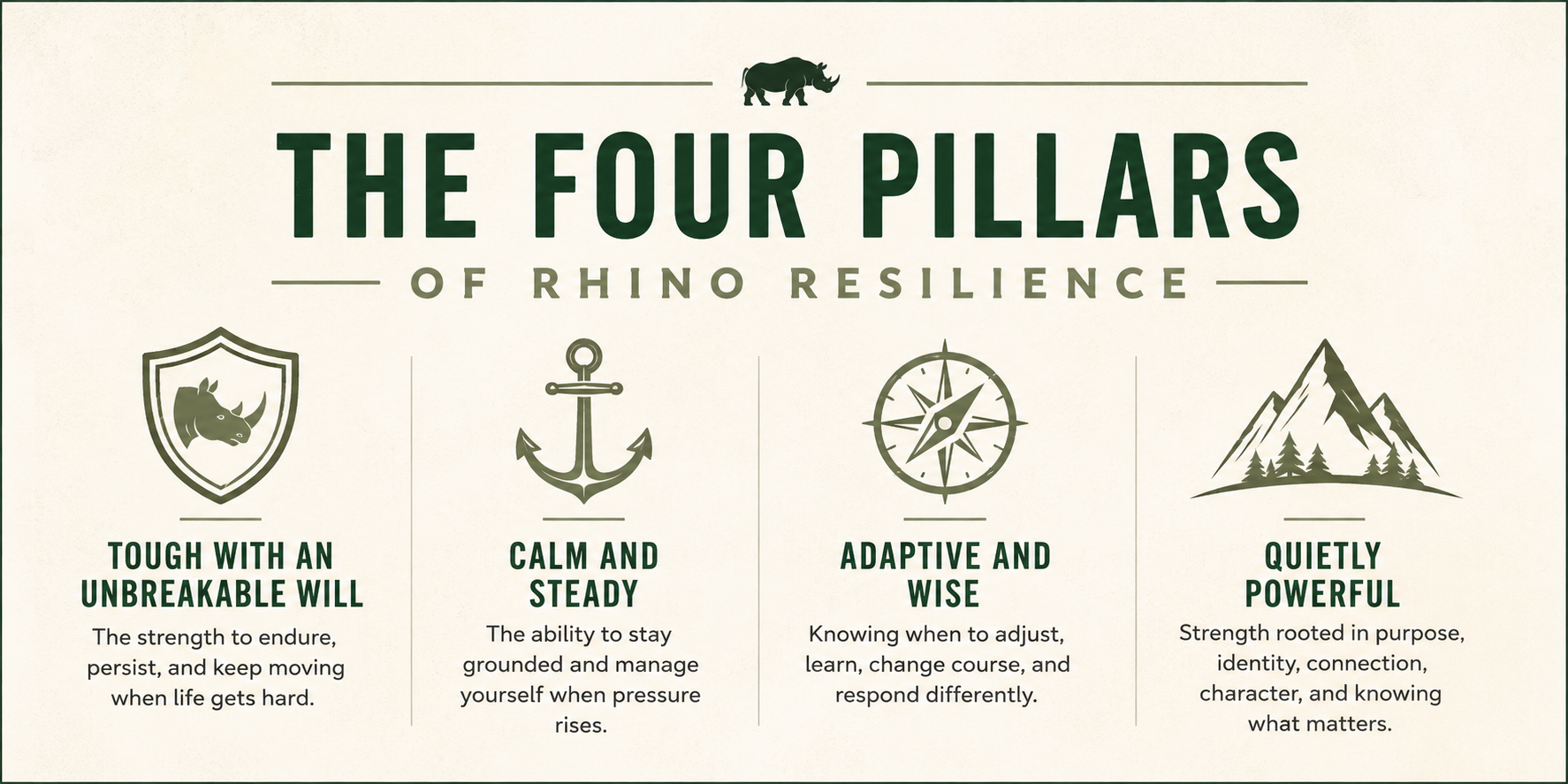
These aren’t four steps to complete. They’re different capacities we build and draw from depending on what life requires. They became the framework underneath the work I do today.
But even understanding resilience wasn’t enough. People needed practical ways to use it.
That’s where the simple stories, analogies, mental cues, and lessons that would eventually become Rhino Resilience Thinking Tools began taking shape: Watch Your Gauges. The Tractor Rut. Bring Backup. Remember Who You Are. Carry It Differently.
Not psychobabble.
Something you can remember when life gets real.
THE RHINO BECAME MORE THAN A NAME
Then I Met Marang
By this point, the rhino had been part of my life for nearly two decades. What had started as a symbol during a turning point in my own life had grown into something much deeper. I had become fascinated with rhinos themselves—their strength, their presence, and sadly, the devastating impact of poaching on their survival.
Then one day, while scrolling through Facebook, I came across a post from The Rhino Orphanage in South Africa.
There was a little rhino named Marang.

Marang was only about 10 days old when he was found beside his mother after she had been killed by poachers. At the time, he was the youngest rhino The Rhino Orphanage had ever taken into its care.
He arrived covered in his mother’s blood. Hungry and desperate for something to drink, he had swallowed so much mud that over the following days several kilograms of clay had to pass through his tiny body.
He was a baby. He was vulnerable. He was alone. Without someone stepping in, he wasn’t going to survive.
The people at the orphanage did step in. They cared for him around the clock, and eventually a little lamb named Elsa became one of his early companions.
His mother had been taken from him by human beings.
And now his survival depended on human beings too.
I remember looking at Marang and trying to wrap my mind around what his first ten days of life had been like. For those few days, his mother was his world. And then she was gone.
I found myself wondering how an animal that had experienced something so terrible at the hands of people could ever learn that people could also mean safety.
I know I can’t know what was happening inside Marang’s mind. But after spending my career sitting with people who had experienced terrible things themselves, I couldn’t help seeing something familiar in his journey.
Trauma changes us. Sometimes the very world that once felt safe suddenly doesn’t. And healing isn’t simply a matter of being tough enough to get over it.
It takes safety. It takes time. It takes connection. And sometimes it takes allowing someone else to help carry us for a while.
I began sponsoring Marang and following his journey. And I watched that tiny, vulnerable rhino grow.
The little animal who once needed people around him day and night eventually became what a rhino is supposed to become—a very big dude, living in a protected wild refuge and increasingly able to live life on his own terms.
His name made the story even more meaningful to me.
Marang means “Ray of Sunshine.”
A ray of sunshine that came out of an unimaginably dark beginning.
And somewhere along the way, I realized why his story had affected me so much.
For years, Rhino had represented toughness to me. Plant your feet. Be strong. Keep moving.
But Marang showed me a different picture of strength.
He survived—but he also needed help. He was powerful—but he had also been vulnerable. What happened to him changed his life—but it didn’t have to become the rest of his life.
That is resilience.
Not pretending the trauma didn’t happen. Not proving you never needed anyone. Not simply surviving another day.
Resilience is what allows us to take what happened, heal from what we can, adapt to what has changed, reconnect with life, and keep growing into who we can still become.
Marang didn’t make me Rhino. That journey had begun almost twenty years earlier.
But Marang helped me understand what being Rhino had come to mean.
True strength isn't never needing help. Sometimes true strength is what becomes possible because help arrived when we needed it most.
WHY RHINO RESILIENCE EXISTS
Because Rural Life Is Worth Strengthening
For more than 20 years, nearly every person I’ve worked with as a licensed therapist has lived in a rural community. I’ve seen the pressures that come with rural life—the isolation, uncertainty, long hours, limited resources, and the expectation that sometimes you just need to handle things yourself.
But that’s only part of the story.
I’ve also seen what makes rural life worth fighting for.
I’ve seen neighbors show up when somebody needs help. Families work side by side. People quietly take care of each other without needing recognition. I’ve seen pride in work that matters, connection to land and community, traditions passed from one generation to the next, and places where your word and your willingness to show up still mean something.
There is tremendous strength here. But strength needs to be maintained.
The goal isn’t to make people tougher so they can just keep pushing through more and more. It’s to build the kind of resilience that allows us to keep doing the work we love, caring for the people who matter, and living the lives we value for the long haul.
That means getting better at recognizing when we’re carrying too much. Talking about hard things. Asking for backup. Handling pressure. Adapting when life changes. Staying connected to what matters. And continuing forward without losing ourselves along the way.
That’s where Rhino Resilience began to take shape.
I wanted to take what I had learned beyond the therapy room—not as therapy, but as practical education people could use in everyday life. Real language. Memorable stories. Thinking Tools. Something people could carry with them when life gets real.
Because awareness matters. But awareness should lead somewhere.
Today, Rhino Resilience is growing through the Rural Toolbox, Thinking Tools, podcasts, videos, speaking, training, and lessons from others who know rural life and have something worth passing along.
But underneath all of it is one simple belief:
I don’t want to see everything that’s good about rural life slowly disappear because we weren’t taking care of the people carrying it forward.
Rural communities aren’t problems to be fixed. They’re communities worth investing in. There is wisdom here. Strength here. Beauty here.
We can protect what makes rural life special while becoming better at taking care of ourselves and one another.
That's why Rhino Resilience exists—to strengthen rural life by strengthening the people who call it home.
A NOTE FROM ME TO YOU
I'm Glad You're Here.
If you’ve made it this far, thank you for taking the time to hear my story.
I don’t know what brought you to Rhino Resilience or what life looks like for you right now. Maybe things are going well. Maybe you’re carrying more than most people realize. Or maybe you’re simply looking for something that can help you become a little stronger, steadier, and better prepared for whatever comes next.
Whatever brought you here, I hope you find something useful.
A story that changes the way you see something. A Thinking Tool you remember when you need it. A conversation that makes you think. A reminder of what matters. Or maybe just a few words that help you take the next step.
And if something you find here helps you, pass it along.
Share it with your family. A friend. A neighbor. A coworker. Someone who might need it too.
Because strengthening rural life isn’t something I can do alone. And it isn’t something any one organization can do alone.
We strengthen it together—one person, one family, and one community at a time.
And hopefully, we leave something stronger behind for the people coming after us.
For the long haul.
— Chris “Rhino” Swenson