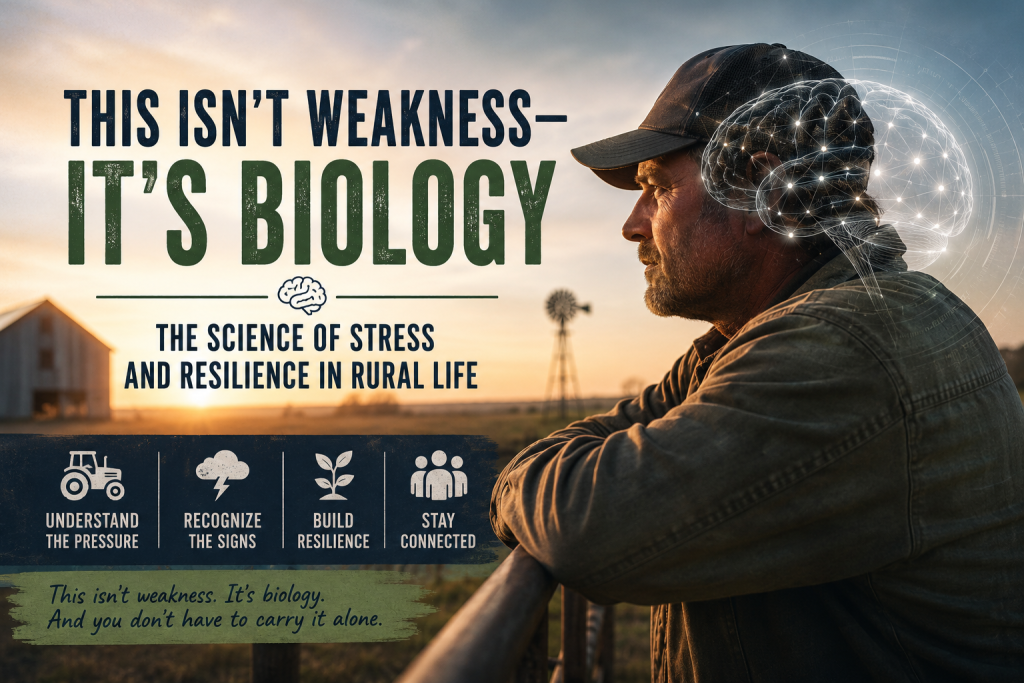
Out here in rural life, people are carrying more than ever.
Long hours. Financial pressure. Weather uncertainty. Family responsibility. Community expectations. Isolation. The pressure to stay strong no matter what.
And yet many rural people still hesitate to talk about stress, overwhelm, anxiety, or emotional exhaustion because somewhere along the way, many of us began believing those struggles meant weakness.
But the truth is this:
A lot of what people are experiencing is not weakness at all.
It is biology.
It is the brain and nervous system responding exactly the way they were designed to respond under pressure.
And understanding that matters.
Because when people understand what is happening inside their brain and body, fear and shame often begin to decrease. Things start making more sense. Instead of feeling broken, people begin realizing:
“My system is overloaded.”
That is a very different conversation.
Your Brain Is Trying to Protect You
The human brain is designed for survival.
When your brain senses danger, pressure, uncertainty, or overload, it automatically shifts into survival mode.
This happens whether the threat is:
- financial stress,
- drought,
- crop loss,
- relationship struggles,
- caregiving exhaustion,
- lack of sleep,
- nonstop responsibility,
- or years of carrying pressure alone.
The brain does not always distinguish between physical danger and emotional stress.
It simply asks:
“Do we need to survive something right now?”
And when the answer is yes, your nervous system activates.
Adrenaline increases.
Cortisol rises.
Heart rate speeds up.
Muscles tighten.
Focus narrows.
Your body prepares to protect you.
This is not weakness.
This is survival biology.
Rural People Understand Stress Systems Better Than They Think
One of the reasons this conversation matters so much in rural communities is because rural people already understand systems, pressure, and wear and tear.
You would never expect a tractor to run at full throttle 24 hours a day without maintenance.
Eventually something overheats.
Something wears down.
Something breaks.
The human nervous system works similarly.
You can push hard for a season.
Sometimes even for a very long season.
But if stress remains high without recovery, the brain and body eventually begin showing signs that the load is becoming too heavy.
Not because you are weak.
Because you are human.
Farmers and ranchers also understand stress in livestock.
Animals under constant stress stop functioning normally too. Their health changes. Their behavior changes. Their systems begin operating differently.
Human beings are no different.
And just like storms give warning signs before severe weather arrives, the nervous system often gives warning signs before people fully crash emotionally or physically.
The problem is many rural people have learned to ignore those signs for far too long.
What Chronic Stress Actually Does to the Brain
Stress itself is not bad.
In fact, stress can help us survive.
Short-term stress can increase:
- focus,
- alertness,
- reaction time,
- and performance.
The problem begins when stress becomes chronic.
When the brain stays stuck in survival mode for too long, it starts changing how a person thinks, feels, reacts, and functions.
People may notice:
- irritability,
- emotional numbness,
- brain fog,
- poor sleep,
- difficulty concentrating,
- increased anger,
- anxiety,
- emotional shutdown,
- constant exhaustion,
- feeling detached,
- or feeling “on edge” all the time.
Many rural people assume:
“I just need to toughen up.”
But often the issue is not lack of toughness.
The issue is that the nervous system has been operating under pressure for too long without enough recovery.
That changes the brain.
Again…
Not weakness.
Biology.
Why So Many Rural People Stay in Survival Mode
Rural culture contains incredible strengths.
Resilience.
Work ethic.
Loyalty.
Persistence.
Responsibility.
Showing up when things get hard.
Those strengths matter deeply.
But sometimes those same strengths can also lead people to carry overwhelming pressure silently for too long.
Many rural people were taught:
- handle it yourself,
- stay tough,
- keep moving,
- don’t burden others,
- don’t complain,
- push through.
And while toughness absolutely has value, toughness alone was never meant to carry nonstop stress forever.
Even the strongest systems require recovery.
The challenge is that survival mode can slowly become normal.
People become so accustomed to stress hormones, pressure, urgency, and emotional suppression that calmness almost starts feeling unfamiliar.
That is one reason some people struggle to slow down, rest, or even sit quietly.
Their nervous system has adapted to constant activation.
Resilience Is Not About Never Feeling Stress
This is important.
Resilience does not mean:
- never struggling,
- never feeling stress,
- never becoming overwhelmed,
- or never needing support.
Real resilience is the ability to recover, regulate, adapt, and continue functioning over the long haul.
A resilient nervous system is not a nervous system that never activates.
It is a nervous system that knows how to come back down.
That is a huge difference.
Because many people are not failing due to lack of strength.
They are exhausted from never leaving survival mode.
The Brain Can Change
Here is the hopeful part.
The brain is adaptable.
The nervous system can learn new patterns.
People can strengthen resilience skills.
This is one reason simple tools can matter so much:
- slowing breathing,
- improving sleep,
- reducing isolation,
- physical movement,
- connection,
- recovery time,
- honest conversations,
- learning emotional regulation,
- faith,
- purpose,
- community support,
- and learning when to bring in backup.
These things are not “soft.”
They are biological interventions that help regulate the nervous system.
Even something as simple as slowing the exhale can begin signaling safety to the brain.
That is science.
Understanding the Science Changes the Shame
One of the most important things rural communities can begin understanding is this:
Many people are not struggling because they are weak.
They are struggling because they have been carrying enormous levels of stress, pressure, uncertainty, and responsibility for too long without enough recovery or support.
The brain and body respond to that.
That response is normal.
Understanding that does not mean we ignore problems.
It means we stop fearing the conversation.
Because when people understand the biology behind stress, they often stop seeing themselves as broken.
And once shame decreases, people become far more willing to:
- learn tools,
- talk honestly,
- support each other,
- seek help earlier,
- and build true resilience.
Final Thoughts
Rural people are some of the strongest people in the world.
But strength was never meant to mean carrying everything alone forever.
Your brain and nervous system were designed to protect you.
The goal is not to eliminate stress completely.
The goal is to learn how to carry stress in a way that allows you to keep living, leading, staying connected, and remaining steady for the long haul.
Because resilience is not about pretending nothing affects you.
It is about understanding what pressure does to the human system — and learning how to respond wisely before the load becomes too heavy.
This isn’t weakness.
It’s biology.
And once we understand that, we can begin building a stronger, wiser, and more resilient rural future together.
Stay steady… we’re in this together.
