Understanding What Today’s Kids Are Carrying—and How We Can Help
Rural Kids Have Always Been Strong… But Something Has Changed
Rural youth have always been known for their toughness.
They grow up learning responsibility early.
They help on the farm, ranch, or around the house.
They understand hard work, family values, and commitment.
But today… something is different.
Behind that strength, many rural kids are carrying more pressure than ever before—and most adults don’t fully see it.
Not because they don’t care…
But because the pressure looks different than it used to.
And if we don’t understand what they’re facing, we can’t help them carry it.
1. The Weight of Social Media Comparison
Years ago, comparison was local.
Now it’s constant.
Rural youth are no longer just comparing themselves to classmates…
They’re comparing themselves to the entire world.
Perfect bodies.
Perfect lives.
Perfect success.
And here’s the hard truth:
👉 Even kids who look confident are quietly asking themselves:
“Am I enough?”
For rural youth, this can hit even harder.
Because while they’re seeing endless opportunities online…
They may feel like they have fewer options in real life.
That gap creates pressure.
2. Limited Opportunities—and Big Decisions Early
Many rural kids grow up with a reality others don’t fully understand:
👉 Opportunities can feel limited.
- Fewer career paths nearby
- Less exposure to different lifestyles
- Fewer extracurricular or advanced programs
So they’re faced with a heavy question earlier than most:
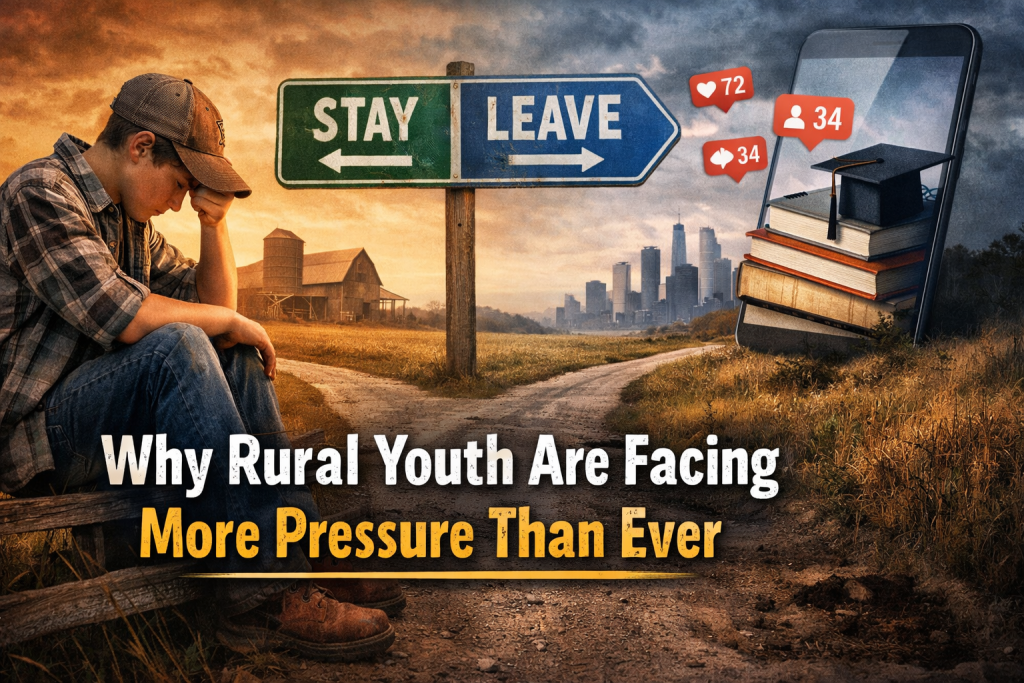
“Do I stay… or do I leave?”
And neither choice is easy.
- Stay → risk feeling stuck or missing out
- Leave → risk losing connection to family, identity, and community
That’s not just a decision…
That’s an emotional weight.
3. The Pressure to Stay… or Go
This is one of the most unspoken pressures in rural life.
Some youth feel:
- “I need to stay and help the family.”
- “I’d be letting people down if I leave.”
Others feel:
- “If I don’t leave, I’ll never become who I could be.”
So they’re caught in the middle:
👉 Loyalty vs. Opportunity
That tension can create guilt, anxiety, and confusion—especially when no one is talking about it openly.
4. Academic Expectations Without the Same Support
Rural students are often told:
👉 “Work hard. Get good grades. Build a future.”
But here’s the challenge:
- Fewer academic resources
- Limited access to tutoring or advanced coursework
- Less exposure to college/career pathways
So the expectation is high…
But the support system isn’t always equal.
That creates frustration.
And sometimes… self-doubt.
5. Limited Access to Mental Health Support
This is one of the biggest challenges rural youth face.
In many communities:
- Mental health services are limited
- Waitlists are long
- Privacy concerns are real (“everyone knows everyone”)
- Stigma is still strong
So what happens?
👉 Kids carry things silently.
They don’t want to be seen as weak.
They don’t want to cause problems.
They don’t want people talking.
So they push through…
Until they can’t.
What Families and Educators Can Do
The goal isn’t to remove pressure completely.
That’s not realistic.
The goal is to help young people carry it differently.
Here’s how we start:
1. Encourage Open, Real Conversations
Not lectures.
Not quick check-ins.
Real conversations.
Try this instead of “How was your day?”:
- “What’s been weighing on you lately?”
- “What’s been stressing you out the most?”
- “What’s something people don’t realize you’re dealing with?”
And then…
👉 Just listen.
Don’t fix it right away.
Don’t minimize it.
Let them feel seen.
2. Teach Simple Coping Skills (That Actually Work)
Resilience isn’t just toughness.
It’s skills.
Start simple:
- Breathing to calm the body
- Naming what they’re feeling
- Breaking big problems into small steps
- Taking intentional breaks
Even one skill can make a difference.
Because when the body settles…
The mind follows.
3. Normalize Struggle (Without Lowering Standards)
We don’t help kids by saying:
“Just tough it out.”
And we don’t help by saying:
“Everything is overwhelming.”
We help by saying:
👉 “This is hard—and you can learn how to handle it.”
Struggle is not failure.
Stress is not weakness.
It’s part of growth.
4. Remind Them They Don’t Have to Have It All Figured Out
Many rural youth feel like they need to decide their entire future… early.
They don’t.
Remind them:
- It’s okay to not know yet
- It’s okay to try things and change direction
- It’s okay to build a path over time
Pressure often comes from thinking:
👉 “I have to get this right right now.”
Help them see:
👉 “You’re allowed to figure this out as you go.”
Final Thoughts: Rural Kids Are Strong—But They Shouldn’t Have to Carry It Alone
Rural youth are capable.
They’re resilient.
They have a strength that runs deep.
But strength doesn’t mean silent struggle.
It doesn’t mean carrying everything alone.
As parents, educators, and community members…
👉 We don’t need to have all the answers.
👉 But we do need to show up.
To listen.
To guide.
To remind them:
“You don’t have to carry this by yourself.”
A Final Word
If you’re raising, teaching, or supporting a young person right now…
Take a moment this week to check in—really check in.
Not just on what they’re doing…
But on what they’re carrying.
Because sometimes the strongest kids…
Are the ones carrying the most.
