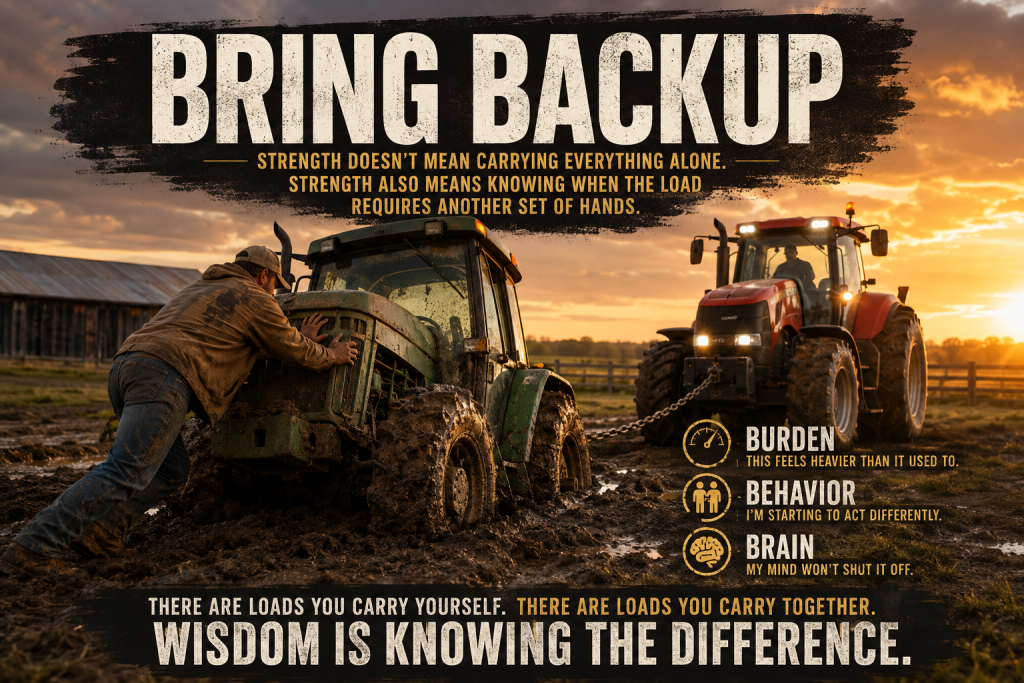
Use this tool when…
You’ve been carrying something for a while, it’s getting harder to handle, and you keep telling yourself you should be able to handle it on your own.
You Already Know How to Bring Backup
Rural people understand backup.
A piece of equipment gets stuck—you call another truck.
A storm is coming and there’s too much work left—you bring in more hands.
Something breaks and you don’t know how to fix it—you call somebody who does.
A situation gets dangerous—you don’t prove how tough you are by making it worse.
You bring backup.
Nobody looks at the second tractor pulling into the field and says the first tractor was weak.
The job required more than one machine.
That’s all.
But something strange happens when we’re the ones carrying the load.
Suddenly the rules change.
I should be able to handle this.
Other people have problems too.
I don’t want to bother anybody.
I’ll get through it.
I just need to toughen up.
So we keep carrying.
And carrying.
Sometimes long after we would have called for backup in any other situation.
Why Do the Rules Change When It’s You?
You would bring backup to protect the crop.
You would bring backup to protect the herd.
You would bring backup to protect the equipment.
You would bring backup to protect somebody you care about.
So why wouldn’t you bring backup to protect the operator?
The same rule applies to you.
Resilience does not mean carrying everything alone.
Sometimes resilience means recognizing:
This load needs another set of hands.
The question is knowing when.
That’s where the Three B’s of Backup can help.
The 3 B’s of Backup
You don’t have to wait until everything falls apart.
Watch for three things.
1. Burden
The burden feels heavier than it used to.
Maybe the situation hasn’t changed much.
But carrying it has.
Things you normally handle are taking more out of you. You’re exhausted. Your patience is getting shorter. You don’t seem to have much left in the tank.
Pay attention to that.
You don’t have to drop the load before admitting it’s getting heavy.
2. Behavior
Your behavior starts changing.
Maybe you’re more irritable.
You’re withdrawing from people.
You’re snapping at people you care about.
You’re drinking more or leaning harder on something else just to get through the day.
You’re working constantly because slowing down means having to think.
You’re avoiding things you normally handle.
You’re just not acting much like yourself.
Sometimes the people around you notice it before you do.
When your behavior starts changing, don’t only ask:
“What’s wrong with me?”
Ask:
“What have I been carrying?”
3. Brain
Your brain won’t shut off.
The problem follows you into the tractor.
Into the pickup.
Into the shower.
Into bed.
You replay conversations.
Run scenarios.
Try to solve the same problem for the hundredth time.
Your body may have stopped working for the day.
Your brain never clocked out.
Pay attention.
It may be another sign that what you’re carrying needs backup.
Don’t Wait for All Three
The Three B’s aren’t a checklist you have to complete before you’re allowed to ask for help.
One may be enough.
The purpose is simple:
Catch it earlier.
Because the earlier you bring backup, the more options you usually have.
Backup Can Look Like a Lot of Things
Bringing backup doesn’t automatically mean going to therapy.
It might mean telling your spouse what’s really going on.
Calling a friend.
Talking with a neighbor.
Sitting down with your pastor.
Calling your doctor.
Talking with a counselor.
Asking somebody to take one job off your plate.
Or simply saying to someone you trust:
“I’m having a harder time with this than I’ve been letting on.”
Different loads require different kinds of backup.
Sometimes you need advice.
Sometimes you need practical help.
Sometimes you need somebody who will listen.
Sometimes you need professional help.
And sometimes you just need another human being standing beside you while you figure out what comes next.
Bringing backup doesn’t mean handing somebody else your load.
Sometimes it simply means getting another set of hands underneath it.
Bring Backup Before You Need Rescue
This is where toughness can get us into trouble.
We wait.
We tell ourselves we’ll handle it.
So we keep pushing until the relationship is falling apart.
Until we’re completely exhausted.
Until alcohol or another escape has become a problem of its own.
Until we can’t sleep.
Until we can’t think clearly.
Until we’re sitting somewhere wondering:
How did I get this far?
You don’t have to wait until the wheels come off.
There is a difference between backup and rescue.
Backup comes while you’re still able to work the problem.
Rescue comes after the problem has overwhelmed you.
Make the call earlier.
That’s not weakness.
That’s good judgment.
Put the Tool to Work
Think about what you’re carrying right now.
Ask yourself:
Burden: Does this feel heavier than it used to?
Behavior: Am I starting to act differently because of it?
Brain: Is my mind having trouble shutting it off?
If one of those gets your attention, ask one more question:
Who is one person I could bring into this?
You don’t need to build an entire support team today.
You don’t have to explain everything perfectly.
You don’t even have to know exactly what you need yet.
Start with one person.
Make the call.
Send the text.
Walk across the yard.
Knock on the door.
And if you don’t know what to say, start here:
“I’ve been carrying something, and I think I could use another set of hands.”
That’s enough to open the gate.
Sometimes Backup Needs to Come Now
Sometimes what you’re carrying becomes more than a Thinking Tool can safely help you handle.
If you’re struggling to stay safe, thinking about hurting yourself, or afraid of what you might do, don’t carry that moment alone.
Bring backup now.
Get another person with you if you can. Call or text 988 for immediate crisis support. If there’s immediate danger, call 911 or go to the nearest emergency room.
There are moments when toughness means holding the line yourself.
And there are moments when toughness means calling somebody to stand on the line with you.
Know the difference.
Remember This
You already know how to bring backup.
You’ve probably done it hundreds of times.
When the work required another set of hands, you found them.
When the equipment wasn’t enough, you brought another machine.
When somebody you cared about needed help, you showed up.
The rule doesn’t change just because you’re the one who needs the help.
There are loads you carry yourself.
There are loads you carry together.
Wisdom is knowing the difference.
Bring Backup.
Dig Deeper
When to Ask for Help: Signs You Need Backup
Sometimes the hardest part of asking for help is knowing when it’s time.
In this episode of The Rhino Resilience Podcast, Chris “Rhino” Swenson digs deeper into why strong, self-reliant people can have such a difficult time bringing in backup when the thing they’re struggling with is themselves.
You’ll hear more about the Three B’s of Backup—Burden, Behavior, and Brain—along with the beliefs and real-world barriers that can make reaching out especially difficult in rural communities.
Chris also shares part of his own experience with PTSD and what it looked like to seek support without giving up his strength or identity.
Because bringing backup isn’t weakness. It’s knowing when a load needs another set of hands.
Possible Other Thinking Tools
Sometimes the first sign that you need backup shows up in your gauges. Learn how to notice changes in sleep, energy, irritability, isolation, hope, and other warning signs before you cook the engine.
You maintain the equipment and the things you depend on. This tool is a reminder that the operator needs maintenance too.
Sometimes the load can’t simply be removed. When that happens, this tool helps you step back, find your options, and discover another way to carry what’s in front of you.