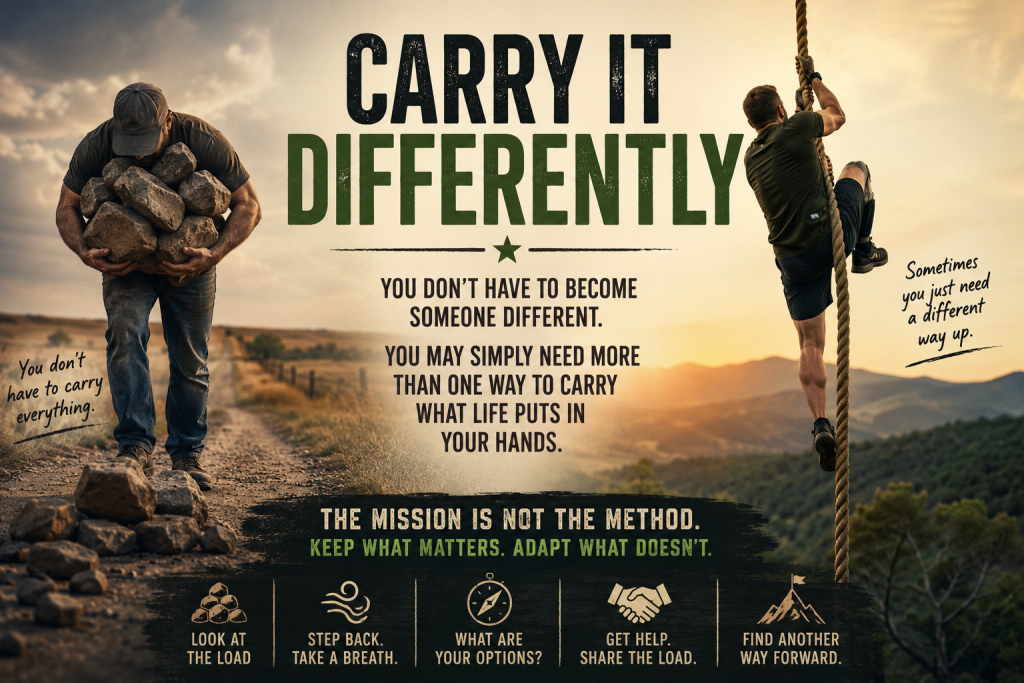
Use this tool when: Life keeps piling things on you, the way you’ve always handled things isn’t working anymore, or you’re wondering how long you can keep carrying everything this way.
The Big Idea
You don’t have to become someone different.
Sometimes you simply need another way to carry what life has put in your hands.
Rural people carry a lot.
Work. Family. Finances. Responsibility. Loss. Weather. Other people’s needs. Things that need fixed—and things that can’t be fixed.
Most of the time, we don’t pick all of it up at once.
We pick it up one piece at a time.
Imagine walking through a field and picking up rocks.
The first rock isn’t that heavy.
Neither is the second.
So you keep walking.
You pick up another. Then another.
Eventually your arms are full. Your shoulders hurt. You’re struggling to hold everything you’ve collected.
If someone walked up at that point and told you:
“You just need to get stronger.”
They might be missing the problem.
Maybe you don’t need stronger arms.
Maybe you need to look at how you’re carrying all those rocks.
Which ones actually need to go with you?
Which ones can be put down?
Which one have you been carrying instead of dealing with?
Which ones belong to somebody else?
Could you make two trips?
Could you use a bucket?
Could somebody grab a few?
That’s what I mean when I say:
Carry it differently.
I’m not asking you to give up your grit, work ethic, independence, sense of responsibility, or willingness to take care of the people who depend on you.
We’re simply adding another question:
Is the way I’m carrying all of this still working?
Find Another Way Up the Rope
Carrying it differently isn’t only about how much you’re carrying.
Sometimes the problem is how you’re trying to do it.
Years ago, I heard a story about a former soldier who competed in military-style competitions.
One of the events involved climbing a rope—and he was incredibly fast.
Then he suffered serious injuries to one of his arms.
He still wanted to compete, but he couldn’t climb the rope the way he always had.
He could have kept forcing the old technique.
Or he could have decided he was finished.
Instead, he looked for another option.
He experimented with his technique and learned to use his body differently. Eventually, he found another way up the rope and was able to remain competitive.
His injured arm was still real.
The rope hadn’t gotten easier.
He changed his approach.
That’s another way of carrying something differently.
What Are Your Options?
I ask people this question all the time:
What are your options?
When we’re overwhelmed, frustrated, scared, or exhausted, our options tend to shrink.
We start thinking:
I have to keep doing this.
Or:
I can’t do this anymore.
But there may be more choices than you can see from where you’re standing.
Maybe you change your pace.
Maybe you break the problem into smaller pieces.
Maybe you finally deal with something you’ve been avoiding.
Maybe you change an expectation.
Maybe you use a different tool.
Maybe something can wait.
Maybe something can be put down.
Maybe you need another set of hands.
Maybe you need another grip on the rope.
The goal isn’t to find the perfect option.
The goal is to stop acting as though the first way is the only way.
The Mission Is Not the Method
Sometimes the way we’ve always done something becomes connected to who we believe we are.
I’ve always handled things myself.
I’ve always been the one people depend on.
This is just how I do things.
There’s nothing wrong with taking pride in being capable and dependable.
But changing your approach doesn’t necessarily mean changing who you are.
The soldier’s mission was to get up the rope and compete.
His old climbing technique was simply the method.
When the method stopped working, he didn’t abandon the mission.
He changed the method so he could continue the mission.
The mission is not the method.
Hold onto what matters.
Be willing to adjust how you get there.
Try This: How Could You Carry It Differently?
When you notice the rocks piling up or the old approach isn’t working, work through these five steps.
1. What am I carrying?
Name it.
What’s weighing on you right now?
What are you responsible for?
What are you worried about?
What have you been avoiding?
Sometimes seeing the whole load explains why it has started feeling so heavy.
2. What actually needs to be carried?
Look at the rocks.
Does everything in your arms belong there?
What matters right now?
What can wait?
What isn’t yours?
What needs to be dealt with rather than carried around?
What might need another set of hands?
You don’t have to solve everything at once.
3. Step back before you look for options.
When you’re frustrated, overwhelmed, or wound tight, it can be hard to see anything except the problem right in front of you.
So don’t force an answer.
Step back.
Take a couple of slow, deep breaths.
Give yourself a little space from the problem. If you need more time, take it. Walk outside. Get away from the situation for a few minutes. Let yourself settle before deciding what comes next.
Then come back to the question:
What are my options?
Sometimes you don’t need a new answer immediately.
You need enough space to see the answers that were already there.
4. What are my options?
Now widen the field.
If the way you’ve been handling this isn’t working, what else could you try?
Change the pace?
Change the method?
Break it down?
Ask someone?
Learn something?
Put something down?
Take another route?
Don’t stop at:
“This is how I’ve always done it.”
Keep looking.
5. Try another way.
Pick an option and test it.
Pay attention to what happens.
Learn.
Adjust.
Try again if necessary.
Adaptation isn’t having every answer.
It’s being willing to keep looking for a workable way forward.
When “I Can’t” Needs Two More Words
There will be times when the load is genuinely heavy.
This tool isn’t pretending otherwise.
Some circumstances are unfair. Some losses cannot be undone. Some problems require real change. And some loads become too much to carry alone.
But when you catch yourself thinking:
“I can’t do this anymore.”
Before you stop there, add two words:
“I can’t do this this way anymore.”
Those are two very different statements.
The first can close your options.
The second creates a question:
Then how else could I carry it?
Maybe you put down a rock.
Maybe somebody takes a few.
Maybe you find a bucket.
Maybe you change your grip.
Maybe you find another way up the rope.
You don’t have to become someone different.
You may simply need more than one way to carry what life puts in your hands.
Remember This
What are your options?
The mission is not the method.
Keep what matters. Adapt what doesn’t.
When the old way isn’t working, don’t immediately assume you can’t keep going.
Sometimes:
“I can’t do this anymore” needs to become “I can’t do this this way anymore.”
Then step back, look at your options, and find another way forward.
Carry it differently.
When This Tool Isn’t Enough
Sometimes the load has become too heavy to keep working through on your own.
If you’re struggling to stay safe or feel like what you’re carrying is no longer a load to carry alone, call or text 988. If there’s immediate danger, call 911 or go to the nearest emergency room.
Reaching for backup is another way of carrying it differently.
Possible Other Thinking Tools
If this tool fits what you’re carrying, you may also want to explore:
- Bring Backup — when another set of hands needs to become one of your options.
- Watch Your Gauges — when you need to see what the load is doing to the person carrying it.
- Maintain the Operator — when you’ve been taking care of everything except yourself.
- Purpose Is Your GPS — when you need to reconnect with where you’re trying to go and why it matters.