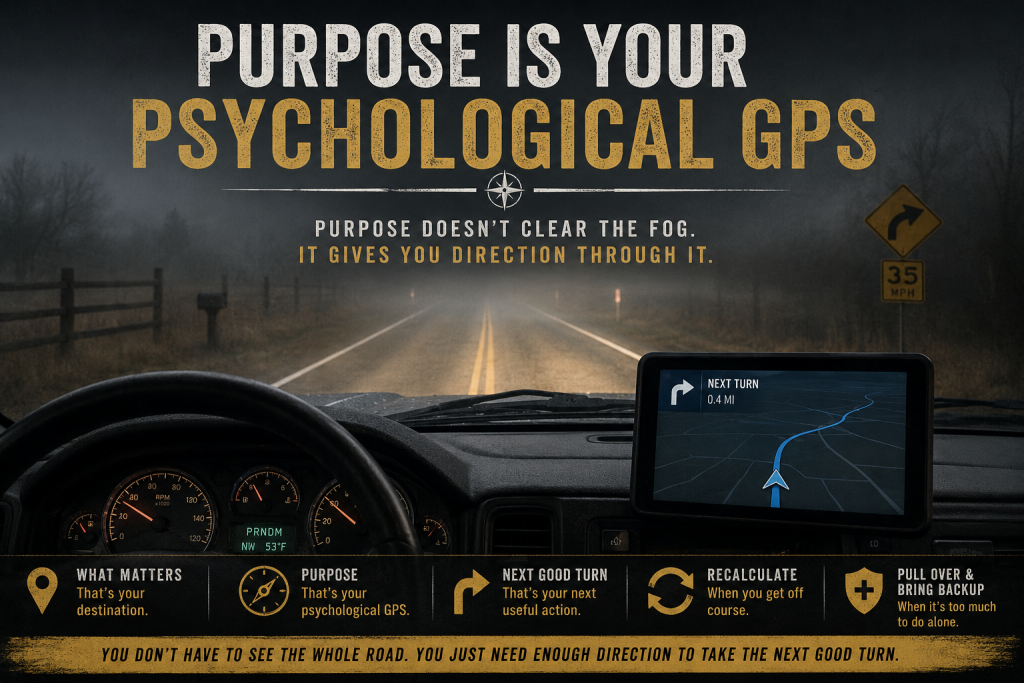
Use this tool when: Life feels foggy and you’re not sure what direction to go next.
There are times in life when you simply cannot see very far down the road.
Imagine driving down a rural highway at night when you suddenly hit thick fog.
Your headlights still work. The road is still underneath you. But you can only see a short distance ahead.
You slow down.
You pay closer attention.
And instead of trying to see miles down the road, you focus on what you can see while checking your GPS for direction.
Life has fog too.
Loss. Pain. Pressure. Failure. Conflict. Change. Uncertainty.
Sometimes the fog gets so thick that you find yourself asking:
Where am I going from here?
That’s when you need your psychological GPS.
Your purpose is your psychological GPS.
Purpose Doesn’t Clear the Fog
Purpose doesn’t make everything suddenly make sense.
It doesn’t necessarily explain why something happened.
It doesn’t take away grief.
It doesn’t solve every problem.
And it certainly doesn’t give you a detailed map of the next ten years.
Purpose doesn’t clear the fog. It gives you direction through it.
When life becomes uncertain, we often start demanding answers to enormous questions:
How is all of this going to turn out?
How am I going to fix everything?
What am I supposed to do with the rest of my life?
What if I make the wrong decision?
Those are difficult questions when you can barely see the road in front of you.
You may not need to figure out the entire journey right now.
You may only need enough direction to find your next good turn.
Your GPS Needs a Destination
Think about an actual GPS.
Before it can give you directions, it needs some idea of where you’re trying to go.
Your psychological GPS works the same way.
That doesn’t mean you need to discover one enormous mission that explains your entire life.
Purpose can be much simpler than that.
Your purpose grows out of what matters enough to help guide the way you live.
Your family.
Your faith.
Your marriage.
Your farm or ranch.
The people who depend on you.
Serving your community.
Building something worth leaving behind.
Being the kind of father, mother, spouse, friend, leader, neighbor, or human being you want to be.
Sometimes, during a particularly difficult season, your purpose may simply be protecting what matters while you make it through.
So before asking which road to take, ask:
What am I trying to move toward?
You don’t need your entire life mapped out.
But knowing what matters gives your psychological GPS somewhere to point.
Run a Psychological GPS Check
When the fog rolls in, stop demanding that you see the whole road.
Check your GPS.
1. What matters most here?
Strip away some of the noise.
What are you actually trying to protect, preserve, repair, build, serve, or become?
Not what fear is screaming at you to do.
Not simply what everybody else expects from you.
What actually matters?
That’s your direction.
2. Who do I want to be while I go through this?
Purpose isn’t only about where you’re going.
It’s also about who you want to be while you’re getting there.
You may not control what happens next.
But you still have some say in how you meet it.
Ask yourself:
When I look back on this season someday, how do I want to have carried myself through it?
3. What’s my next good turn?
Now make purpose practical.
Don’t figure out the next ten turns.
Find one.
Your next good turn might be:
- making the phone call you’ve been avoiding
- having the difficult conversation
- apologizing
- asking for help
- getting some sleep before making a major decision
- saying no to something pulling you away from what matters
- showing up again tomorrow
- making the appointment
- spending time with someone you love
- getting professional help
- deciding that tonight is not the night to make a life-changing decision
You don’t have to see the whole road.
Find the next good turn.
Then take it.
Sometimes the GPS Says: Recalculating
Here’s one of the best things about a GPS.
You miss your turn.
What happens?
It doesn’t say:
“Well, you blew it. Trip’s over.”
It says:
Recalculating.
That’s a pretty good lesson for life.
Maybe you made a decision you regret.
Maybe you’ve spent months—or even years—moving in a direction that doesn’t fit who you want to be anymore.
Maybe you drifted away from something that matters.
Or maybe you didn’t do anything wrong at all. Something outside your control simply closed the road you thought you were going to travel.
Either way, sitting beside the road beating yourself up won’t get you where you’re trying to go.
Recalculate.
Ask again:
What matters now?
Who do I want to be now?
What’s my next good turn?
Getting off course doesn’t mean you have to stay off course.
Your psychological GPS can help you find another way forward.
Sometimes You Need to Pull Over
There are times when the fog becomes so thick that continuing to drive isn’t the smartest thing to do.
You slow down.
And sometimes you pull over.
You get your bearings.
You call someone.
You wait until you can safely move again.
Life has those moments too.
Sometimes your next good turn is not pushing forward alone.
It’s bringing backup.
If the burden feels heavier than it used to, your behavior is starting to change, your brain won’t shut off, or you’re struggling to stay safe, this may be more than a Thinking Tool can carry.
This is no longer a load to carry alone. Bring backup now.
If you’re struggling to stay safe or thinking about suicide, call or text 988 in the United States to reach the Suicide & Crisis Lifeline. If you’re in immediate danger, call 911 or go to the nearest emergency department.
Asking for help doesn’t mean you’ve abandoned the journey.
Sometimes bringing backup is your next good turn.
Take This With You
There will be seasons when you can see miles down the road.
And there will be seasons when you can barely see beyond your headlights.
When the fog rolls in, don’t demand that you understand the entire journey.
Check your psychological GPS.
Ask:
What matters?
Who do I want to be through this?
What’s my next good turn?
And when you get off course:
Recalculate.
Remember:
Your purpose is your psychological GPS. Purpose doesn’t clear the fog. It gives you direction through it.
You don’t have to see the whole road.
You just need enough direction to take the next good turn.
If This Tool Helped, You May Also Like
When the fight gets loud and you begin losing touch with what matters, step back and reconnect with who you are and what you’re fighting for.
Learn to notice when you’re gradually moving away from where you want to be—and make the correction before you end up somewhere you never intended to go.
When the road you’ve been taking isn’t working anymore, step back, look for options, and find another way to carry what life has put in front of you.