Use this tool when…
Something in your life has been getting a little farther off track, but it doesn’t seem serious enough yet to do anything about it.
The Tool
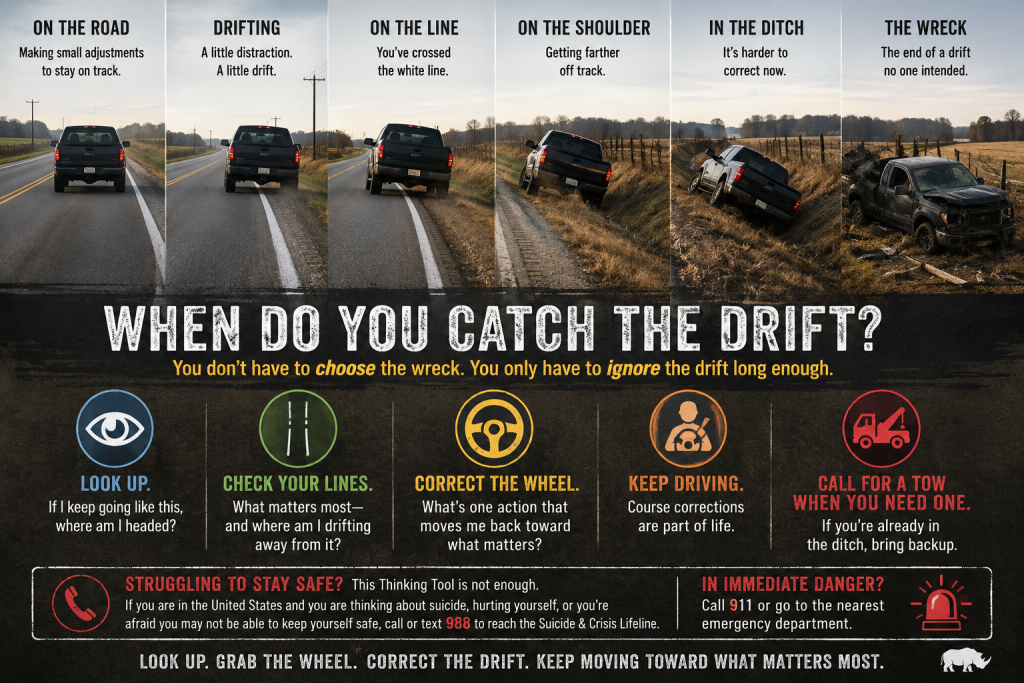
Think about driving down a rural highway.
Even when the road looks perfectly straight, you’re constantly making tiny adjustments to the steering wheel.
A little left.
A little right.
Back toward the center.
Most of the time, you don’t even realize you’re doing it.
That’s just driving.
But imagine something gets your attention.
You look away from the road.
The vehicle begins to drift.
At first, it’s only a few inches. Nothing dramatic happens. You’re still on the highway.
But you stay distracted.
Your tires reach the white line.
Then the rumble strip.
Then the shoulder.
Then the ditch.
And if you don’t catch it—
you can wreck.
Nobody got into the vehicle planning to wreck it.
They just didn’t catch the drift soon enough.
Life Can Work the Same Way
Most of us don’t intentionally wreck the things that matter most to us.
Nobody wakes up thinking:
I want to become distant from my spouse.
I want to lose connection with my kids.
I want to stop talking to my friends.
I want work to consume everything else in my life.
I want to stop taking care of myself.
I want to become someone I don’t recognize.
But we can drift there.
Usually, it doesn’t happen all at once.
We’re tired.
We’re busy.
We’re hurting.
Something demands our attention.
One thing gets neglected.
Then another.
Each individual change seems small enough that we tell ourselves:
I’m fine.
But small movements in the same direction eventually take us somewhere.
You don’t have to choose the wreck. You only have to ignore the drift long enough.
That’s why the question isn’t whether you’ll ever drift.
We all do.
The question is:
When Do You Catch the Drift?
Do you notice when you’re six inches over the line?
When you hit the rumble strip?
When you’re on the shoulder?
When you’re already in the ditch?
Or only after something important has been wrecked?
The earlier you catch the drift, the smaller the correction usually needs to be.
1. LOOK UP
You can’t correct a drifting vehicle while you’re still looking away from the road.
Sometimes life requires the same thing.
Get your attention off whatever has consumed all of it for a moment and look at the direction you’re traveling.
Ask yourself:
If I keep living exactly like this, where am I headed?
Don’t only evaluate how things are today.
Look at the trajectory.
You can still be functioning while slowly heading somewhere you don’t want to go.
2. CHECK YOUR LINES
The lines on a highway help you recognize when you’re leaving the road.
You need some lines in life too.
Those lines are what matters most to you.
Your family.
Your relationships.
Your health.
Your values.
Your integrity.
Your faith or sense of purpose.
The people and things that make your life worth all the work you’re putting into it.
Ask yourself:
What matters most to me?
Then ask the harder question:
Where am I drifting away from it?
Maybe you’ve stopped calling someone.
Maybe you’re becoming more irritable at home.
Maybe work has swallowed everything.
Maybe you’re drinking more than you used to.
Maybe you’ve stopped doing things you enjoy.
Maybe you’ve been pulling away from people.
Maybe you’re neglecting yourself.
Maybe somewhere along the way you became so busy handling the next responsibility that you lost sight of what all that work was supposed to protect.
Pay attention to the line.
3. CORRECT THE WHEEL
If your tires barely cross the white line, you don’t need to panic and jerk the steering wheel.
You make a correction.
Life doesn’t always require a dramatic overhaul either.
Ask:
What’s one thing I can do that moves me back toward what matters?
Make the phone call.
Go home a little earlier.
Put the phone away.
Apologize.
Restart the routine you’ve abandoned.
Have the conversation you’ve been avoiding.
Spend some time with somebody you’ve been missing.
Say no to something that’s pulling you farther away.
Ask for help.
Sometimes a small correction made early prevents a much larger correction later.
4. KEEP YOUR HANDS ON THE WHEEL
Here’s something we sometimes forget:
Good drivers are constantly correcting.
They don’t consider every small adjustment evidence that they’re terrible drivers.
It’s part of driving.
Life is no different.
You’re going to drift sometimes.
Stress will pull you.
Responsibilities will demand your attention.
Hard seasons will knock you off course.
You may realize you’ve gotten farther away from something important than you intended.
Notice it.
Correct.
Keep going.
Needing to correct your course doesn’t mean you’re failing. It means you’re paying attention.
5. IF YOU’RE ALREADY IN THE DITCH, BRING BACKUP
Sometimes we catch the drift early.
Sometimes we don’t.
There are situations where you’re no longer six inches across the line.
You’re in the ditch.
At that point, simply turning the steering wheel may not be enough.
And spinning the tires harder can dig you even deeper.
The same is true in life.
There are times when the strongest next move isn’t trying harder by yourself.
It’s bringing in backup.
That might be your spouse, a trusted friend, family member, pastor, doctor, therapist, recovery support, or someone else equipped to help with what you’re carrying.
You may need someone to help you find your way back onto the road.
Remember This
LOOK UP
If I keep going like this, where am I headed?
CHECK YOUR LINES
What matters most—and where am I drifting away from it?
CORRECT THE WHEEL
What’s one action that moves me back toward what matters?
KEEP DRIVING
Course corrections are part of life.
CALL FOR A TOW WHEN YOU NEED ONE
If you’re already in the ditch, bring backup.
And keep asking yourself:
When do I catch the drift?
Because most of the things that matter in our lives aren’t wrecked in one moment.
Sometimes we simply drift farther and farther away from them.
Look up. Grab the wheel. Correct the drift.
Then keep moving toward what matters most.
When This Tool Isn’t Enough
Sometimes the drift has carried you farther than a simple course correction can fix.
If you’re overwhelmed, becoming increasingly isolated, relying more heavily on alcohol or drugs, struggling to function, or repeatedly trying to get yourself back on course without success, bring in backup.
Talk with someone you trust or reach out to a qualified professional who can help you carry what you’re dealing with.
If you’re thinking about suicide, hurting yourself, or you’re afraid you may not be able to keep yourself safe, call or text 988 to reach the Suicide & Crisis Lifeline. If there is immediate danger, call 911 or go to the nearest emergency department.
A Thinking Tool can help you recognize what’s happening.
Sometimes you need another person beside you to help you get back on the road.
Dig Deeper
Why Rural People Handle Life Alone | The Slow Drift Into Isolation
In this episode of The Rhino Resilience Podcast, Chris takes the idea of drift deeper by exploring one particular direction rural people can slowly travel without realizing it:
Isolation.
Strong, hardworking people don’t usually decide one day that they’re going to disconnect from everyone around them. It can happen gradually while they’re still working, providing, solving problems, and appearing to function just fine.
Chris shares his own experience of slowly moving toward burnout, emotional exhaustion, and isolation—a season that eventually led him to an emergency room believing he was having a heart attack.
The episode explores why vulnerability can begin to feel risky, how our sense of worth can become connected to being strong and useful, how self-reliance can gradually become isolation, and why stress can disconnect us not only from other people but also from ourselves.
Most importantly, it asks the same question at the heart of this Thinking Tool:
Can we recognize the drift sooner—and begin reconnecting before the cost becomes too high?
Possible Other Thinking Tools
If this tool connected with you, these may help too:
Remember Who You Are
When you’ve gotten so caught up in the fight that you’re losing sight of who you are and what you’re fighting for.
Watch Your Gauges
Learn to recognize the warning signs that you’re running too hot before useful stress becomes damage.
Purpose Is Your GPS
When life gets foggy, confusing, or painful, reconnect with what gives you direction.
Bring Backup
When you’ve moved beyond a course correction and need another person to help carry the load.
The Tractor Rut
When you keep getting pulled back into the same reactions or patterns even though you want to choose a different path.