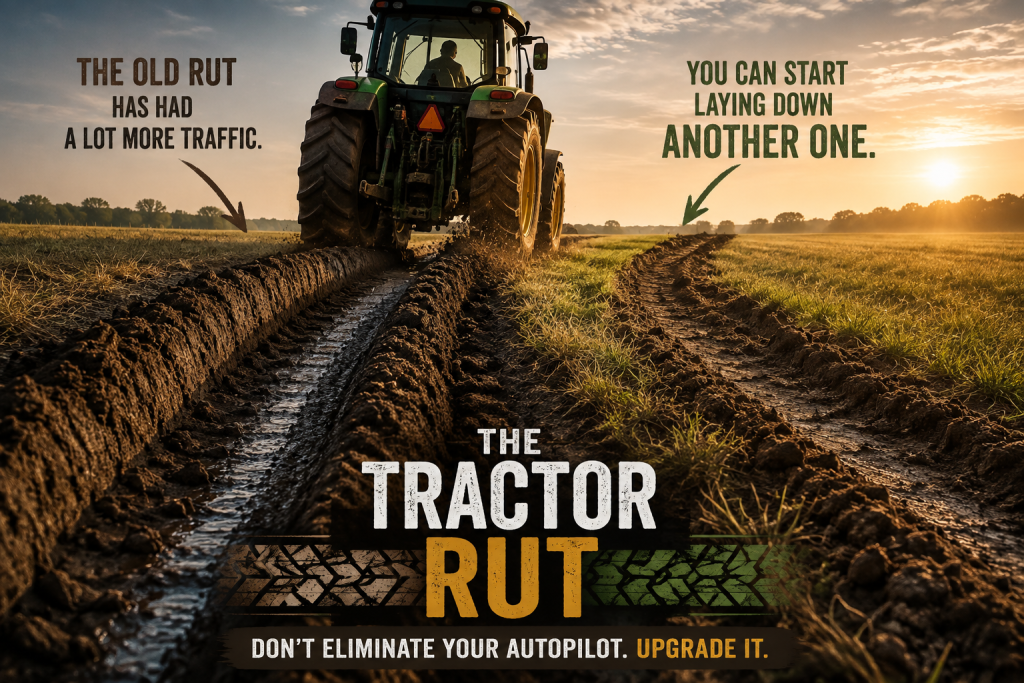
Don’t eliminate your autopilot. Upgrade it.
Use This Tool When…
Use The Tractor Rut when you notice yourself reacting the same way you always do—especially when you’re stressed, frustrated, overwhelmed, hurt, afraid, or under pressure.
Maybe you get angry.
Maybe you shut down.
Maybe you avoid.
Maybe you assume the worst.
Maybe you try to control everything.
Maybe you pull away and handle everything yourself.
Whatever your pattern is, there are moments when it can feel like the reaction happens before you ever really chose it.
That’s when it’s time to remember The Tractor Rut.
Picture This
If you’ve spent much time around farming, you’ve seen what happens when tractor tires travel the same ground again and again.
Tracks form.
Keep driving those same tracks and they get deeper.
Eventually, when the tractor drops into them, the tires naturally want to follow the path that’s already there.
But you don’t have to farm to know this feeling.
Spend a winter driving the streets of a small rural town that doesn’t get every inch of snow cleared away.
Vehicle after vehicle travels the same path. The snow gets packed down. It freezes. More vehicles follow those same tracks.
Pretty soon you’ve got two hard, icy ruts running down the road.
Your tires drop into them…
and suddenly the rut starts doing some of the steering for you.
Your hands may still be on the wheel.
But the vehicle wants to follow the path that’s already been traveled.
Your brain does something very similar.
Your Brain Creates Ruts
Your brain learns from repetition.
The more often you think, react, or respond a certain way, the easier it becomes to follow that same path again—like tires settling into a rut.
That’s not necessarily a bad thing.
Your brain is designed to make repeated things easier and more automatic.
Think about everything you do without consciously walking yourself through every step.
Driving.
Doing familiar work.
Completing chores you’ve done thousands of times.
Responding quickly when something familiar happens.
That automatic ability saves time and energy.
It’s your autopilot.
The problem isn’t that you have an autopilot.
The question is:
Where is your autopilot taking you?
The Tractor Rut helps you notice the automatic paths you’ve developed and decide which ones are helping you, which ones aren’t, and which ones need to be retrained.
The goal isn’t to eliminate your autopilot. It’s to upgrade your autopilot.
When the Rut Starts Steering
Our reactions can become automatic too.
Something happens…
and before we’ve really thought about how we want to respond, the tires are already dropping into the familiar tracks.
Someone criticizes you.
Defend yourself.
Something goes wrong.
Assume the worst.
You’re overwhelmed.
Shut everybody out.
You feel uncertain.
Try to control everything.
You’re hurting.
Keep it to yourself and work harder.
Someone makes you angry.
Fire right back.
Those reactions may happen so quickly that they don’t feel like choices anymore.
They just feel like:
“That’s the way I am.”
But sometimes what we call who I am is actually how I’ve learned to respond.
You’ve driven that road so many times that the tires know exactly where to go.
And once you’re deep enough in the rut…
the rut starts doing some of the steering.
Not Every Rut Is Bad
This Thinking Tool isn’t about treating every automatic reaction like a problem.
You have good ruts too.
Maybe when something breaks, you automatically start looking for solutions.
Maybe when there’s an emergency, you become calm and focused.
Maybe you’ve trained yourself to stop and think before making an important decision.
Maybe when someone you care about is struggling, you check on them.
Maybe when you’ve made a mistake, you’ve learned to admit it, adjust, and keep moving.
Those are ruts worth keeping.
So the goal isn’t:
Get rid of the ruts.
It’s:
Know your ruts.
Which ones take you somewhere useful?
Which ones keep taking you somewhere you don’t want to go?
And which new ones do you need to start building?
Work the Tool
1. Recognize Your Rut
Start by noticing what happens automatically.
Ask yourself:
What do I usually do when ______ happens?
Think about a situation that regularly gets a reaction from you.
When I’m criticized, I usually:
When I’m overwhelmed, I usually:
When I’m angry, I usually:
When I don’t know what’s going to happen, I usually:
When I’m hurting, I usually:
When something doesn’t go according to plan, I usually:
Don’t judge it yet.
Just identify the tracks.
What does your autopilot usually do?
2. See Where the Rut Takes You
Now follow the tracks.
Ask:
Where does this reaction usually take me?
Does it help?
Does it solve the problem?
Does it make things worse?
Does it protect something important?
Does it damage something important?
How do I usually feel afterward?
What happens to the people around me?
Does this response move me toward the person I want to be—or away from that person?
Some ruts will be worth keeping.
Others may have been taking you somewhere you don’t want to go for years.
You can’t decide which ruts need changing until you know where they’re taking you.
3. Find Another Path
Here’s where autopilot can fool us.
When we’ve traveled the same rut long enough, it can begin to feel like the only path available.
But it isn’t.
You may not control what happened.
You may not control what someone else did.
You may not control the weather, the market, the diagnosis, the mistake, the argument, the setback, or whatever else landed in front of you.
But there may be more than one way to respond.
So ask:
What else could I do here?
You don’t need ten choices.
You may only need one additional path.
Because:
If all you have is one reaction, life controls you.
The more responses you develop, the more ability you have to meet the situation in front of you instead of automatically giving it the same reaction you’ve always given it.
4. Decide Which Rut You Want
Now make it specific.
Instead of only saying:
“I don’t want to react like that anymore.”
decide:
What do I want my autopilot to eventually do instead?
Maybe:
Old rut: Get angry → fire back.
New rut: Get angry → slow down → respond.
Or:
Old rut: Feel overwhelmed → isolate.
New rut: Feel overwhelmed → tell someone → ask for backup.
Or:
Old rut: Something goes wrong → immediately assume the worst.
New rut: Something goes wrong → get the facts → decide what actually needs to happen next.
You’re not simply trying to stop traveling the old path.
You’re deciding where you want the new one to go.
Now Drive the New Rut
This may be the most important part of the entire Thinking Tool.
Knowing the better response doesn’t automatically make it your new response.
You have to practice it.
Imagine creating a new tractor path across a field.
You drive across it once.
There might be some tire marks.
But there’s not much of a rut yet.
So you drive it again.
Then again.
Then again.
Each pass makes the track a little more established.
Your brain learns through repetition too.
Every time you practice the response you want, you’re putting another set of tire tracks into the new rut.
At first, the new response may feel awkward.
Slow.
Deliberate.
The old reaction may still feel much easier.
Of course it does.
The old rut has had a lot more traffic.
Don’t mistake familiar for better.
And don’t expect one good response to erase a pattern you’ve practiced hundreds or thousands of times.
Keep driving the new route.
Every repetition matters.
Practice Before You Need It Most
Don’t wait for the hardest moment of your life to practice the response you want available during the hardest moment of your life.
Use the smaller moments.
Someone irritates you?
Practice slowing down.
Plans change unexpectedly?
Practice adapting.
You’re having a rough day and want to disappear?
Practice reaching out.
Something small goes wrong?
Practice getting the facts before assuming the worst.
These moments are reps.
You’re putting tire tracks into the new path.
Because when real pressure arrives, your brain is more likely to reach for a path it already knows.
Pressure reveals what we practiced.
Practice the response you want available when the pressure comes.
Build Your New Rut
Choose one reaction you’d like to work on.
My Old Rut
When:
My autopilot usually:
Where Does That Rut Take Me?
What Other Response Is Available?
The New Rut I Want to Build
When:
I want to practice:
Now look for opportunities to drive that new route.
Not perfectly.
Repeatedly.
Your Retrieval Cue
You don’t need to remember this whole page when life gets hard.
Remember the tires dropping into the tracks.
Remember what happens next:
The rut starts doing some of the steering.
When you catch an automatic reaction taking over, tell yourself:
“I’m in the rut.”
Then ask:
“What path do I want to drive instead?”
That may be all you need to interrupt the old autopilot long enough to choose another response.
A Phrase to Carry With You
“Don’t eliminate your autopilot. Upgrade it.”
Your brain is going to create ruts.
Let it.
Just pay attention to where they’re taking you.
Keep the ones that serve you.
Retrain the ones that don’t.
And repeatedly practice the responses you want your brain to find when life gets difficult.
Because eventually, the path you’re deliberately practicing today can become the path that’s easier to travel tomorrow.
Remember the Picture
You don’t need to remember everything you learned here.
Just remember the rut.
Picture tractor tires settling into well-traveled tracks.
Or picture your vehicle dropping into the frozen tire ruts running through a small-town street.
Feel that steering wheel tug.
The vehicle wants to follow the tracks already there.
When you notice the same thing happening inside yourself:
I’m in the rut.
And then remember:
You aren’t limited to the path that’s already there.
You can start laying down another one.
One pass at a time.
Safety Check
Sometimes the rut you’re caught in involves more than an unhelpful reaction. If you’re struggling to stay safe or feel like what you’re carrying is no longer a load to carry alone, call or text 988.
If there’s immediate danger, call 911 or go to the nearest emergency room.
Calling for backup is not weakness. Sometimes it’s the next path that needs to be taken.
Dig Deeper
Watch The Tractor Rut
If this Thinking Tool connected with you and you’d like to go deeper, watch this episode of The Rhino Resilience Podcast.
Chris walks through The Tractor Rut—how our automatic reactions develop, why familiar paths can begin steering us, and how we can practice better responses until they become part of our autopilot.
Possible Other Thinking Tools
If The Tractor Rut helped you, you may also want to explore:
Learn to recognize when you’re pushing beyond a safe operating range before something breaks down.
Notice when you’re slowly moving away from what matters and make the correction before you end up somewhere you never intended to go.
Know when the load has become too heavy to keep carrying alone.
Recognize when your current emotional state is shaping what you see and limiting the options you can recognize.